
Bring your Sora footage back to life at 4K · 8K · 16K
OpenAI's Sora service has ended, but the clips you made are still yours. Clean up their blur and AI look with non-generative post-processing — up to 16K, without touching the original.
What's holding back the Sora footage in your library
Sora created stunning shots, but the clips left behind have clear limits in resolution and detail. You can't re-generate them anymore — but you can lift their quality.
Native 1080p ceiling
Sora output tops out around 1080p — put it on a big screen and pixel detail falls short.
Lingering AI look
Faces, hair and textures still carry diffusion's soft smearing and plastic feel.
Clips you can't remake
With the service gone, restoring the originals you already have is the only way to improve them.
What AI PIXELL does
Real resolution increase
Not stretching — it restores detail up to 4K, 8K and 16K (max 16K).
Non-generative, original untouched
The AI never repaints. Only existing information is sharpened — no face or detail distortion.
Noise & artifact cleanup
Removes diffusion residual noise, compression blocking and frame flicker via denoise.
No length limit · one-time purchase
15 seconds or an hour, no limit. A lifetime license instead of a subscription.
The blur disappears,
real detail comes back
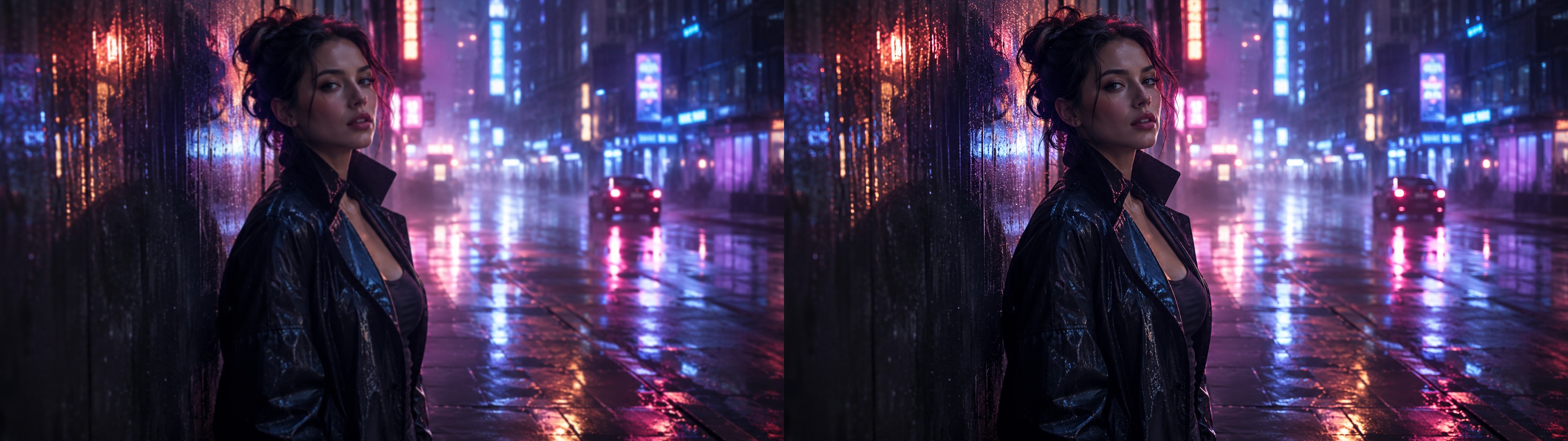
Lift native 1080p Sora footage to 4K and 8K — faces, detail and texture kept natural.
How it works
Generate
Make your video with your usual AI model.
Upload
Load the exported file into AI PIXELL.
Set & preview
Pick resolution and model, then preview the result.
Export
Export at 4K, 8K or 16K and publish anywhere.
Where does the “AI look” come from?
Diffusion models build video by removing noise step by step. Structural flaws that never get fully removed remain in that process — and that is exactly what reads as the “AI look.” AI PIXELL cleans up only those traces, non-generatively.
Residual noise at the last step
The noise schedule fails to drive SNR to zero at the final denoising step, so tone gets trapped in mid-brightness and contrast is flattened. (WACV 2024)
Error accumulating each step
Estimation error compounds across steps (exposure bias), collapsing detail and distorting texture — worse with fewer steps. (ICLR 2024·2025)
High-frequency detail loss
Generated in a compressed latent then upsampled, fine detail like pores, fabric weave and hair gets smeared.
Plastic texture
Denoising toward an “average skin” erases texture while over-sharpening edges, giving a synthetic, CGI-like look.
Inter-frame flicker
An image-trained VAE decoder introduces subtle inter-frame shimmer when turning latents back into pixels.
Suppressed real-footage grain
Smoothing frames to stop face jitter also suppresses the sensor grain of real footage, so it reads plastic on playback.
Sources: “Common Diffusion Noise Schedules and Sample Steps are Flawed” (ByteDance, WACV 2024) · Exposure Bias in Diffusion Models (ICLR 2024·2025)
Beyond Sora 4K — up to 8K and 16K
Portfolio, archive or exhibition — export your saved Sora footage at the resolution you need.
Who it's for
Designers & video editors
Anyone finishing generative sources to delivery quality.
YouTubers & creators
Publish short- and long-form in 4K for a competitive edge.
Companies & brands
Teams outputting bulk AI ad/campaign clips at consistent quality.
Every creator
Anyone who wants to erase the AI look and make video feel real.
Frequently asked questions
It's time to bring your best Sora shots back at 4K
Turn the blurry Sora footage left in your library into 4K, 8K and 16K. Start post-processing with AI PIXELL now.